People often call cats mysterious, but a cat is talking almost constantly, just not in a language most of us were taught. Where a dog broadcasts its mood in big, obvious gestures, a cat speaks in the subtle grammar of tail tips, ear angles, and the softness around its eyes. Miss those signals and a cat can seem moody or unpredictable; learn them and it turns out your cat has been remarkably clear all along.
Reading body language is the closest thing there is to a superpower with cats. It lets you tell an invitation from a warning, back off before a friendly moment turns into a scratch, and understand what your cat actually enjoys. None of it is complicated, and once you start noticing, you won't be able to stop.
Start with the tail#
The tail is a cat's most expressive feature, a mood flag you can read across the room. A tail carried straight up as your cat approaches, sometimes with a little hook at the tip, is the feline equivalent of a warm hello, a sign of confidence and friendly intent. Greet that tail with a soft voice and you're speaking your cat's language.
Movement tells the rest of the story. A gently swaying or slowly curling tail usually means a relaxed, thoughtful cat, while a tail that lashes or thumps hard against the floor is a clear signal of irritation or overstimulation, often just before a cat has had enough of petting. A tail puffed out into a bottle brush, paired with an arched back, means the cat is frightened and trying to look bigger. And a tail tucked tight against the body says the cat feels anxious and wants to shrink out of sight.
There's also the little quiver you might notice when your cat trots up to greet you, tail held high and vibrating rapidly at the tip. That happy tremble is a strong sign of excitement and affection, the greeting a cat reserves for someone it's genuinely pleased to see. Learn to spot it and you'll know exactly when your cat is delighted you walked through the door.
Watch the ears and eyes#
Ears are precision instruments, swivelling to track sound but also flagging emotion. Ears turned forward and upright belong to an alert, interested cat, the look you'll see during play or when something new appears. As tension rises, the ears rotate sideways and then flatten back against the head, the so-called "airplane ears" that warn of fear or aggression. When the ears go flat, the conversation is over and the cat needs space.
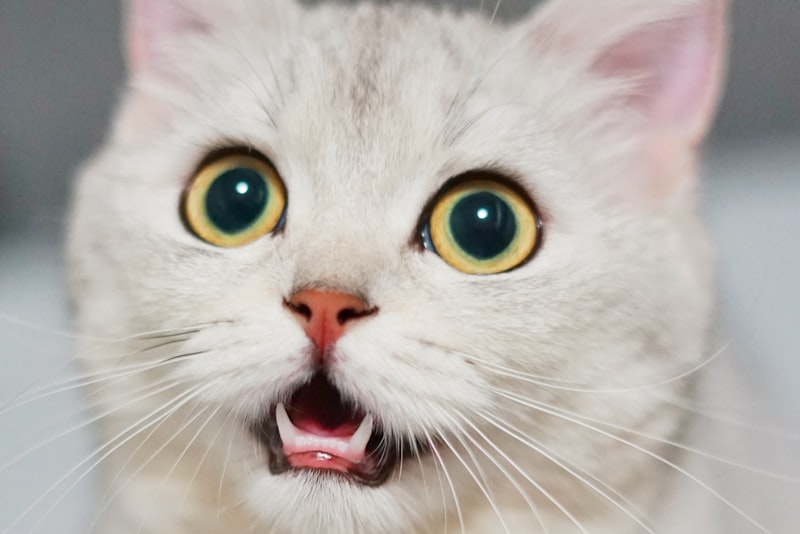
The eyes add another layer. Pupils widen with excitement, fear, or arousal and narrow to slits in bright light or, sometimes, intense focus before a pounce. A hard, unblinking stare is not the friendly gaze it might seem; between cats it's a challenge, and even directed at you it often signals tension rather than affection. The most rewarding eye signal to learn is the opposite of that stare, the slow blink.
A cat that looks at you and slowly closes and opens its eyes is offering what many people call a "cat kiss," a sign it feels safe and content in your company. Return the gesture with your own slow blink and you're telling your cat, in its own vocabulary, that you're relaxed too.
Read the whole posture#
Zoom out from the details and the cat's overall shape tells you how safe it feels. A relaxed cat is a loose cat: lying with paws tucked in a "loaf," stretched out on its side, or sauntering with easy, unhurried steps. When a cat rolls over and shows its belly, it's usually a display of trust rather than an invitation for a tummy rub, so admire it and resist the urge to reach for that exposed stomach.
A worried cat, by contrast, makes itself small and compact. Crouching low with the legs drawn under, tail wrapped tight, and muscles tensed to bolt all say the cat feels threatened and is weighing escape. The dramatic Halloween-cat pose, back arched high and fur standing on end, is a frightened cat trying to look formidable. Faced with any of these, the kindest response is to stop whatever prompted it and give the cat room to reset. Recognizing these shapes early is a huge help when you're settling a nervous newcomer, as how to help a new cat settle in explains.
Listen, but read the body too#
Cats do use sound, and it's worth a note, but vocal cues make the most sense alongside the visual ones. A few common ones:
- A chirp or trill is a friendly greeting, often meaning "follow me" or "hello"
- A purr usually signals contentment, though cats also purr to self-soothe when unwell or stressed
- A drawn-out meow at you is a request, since adult cats mostly meow to communicate with humans, not each other
- A hiss or low growl is an unmistakable "back off," and should always be respected
Because a purr can mean comfort or comfort-seeking under stress, never read a single sound in isolation. A cat purring while curled loosely in your lap is a happy cat; a cat purring while crouched, tense, and hiding may be trying to calm itself. Always let the tail, ears, eyes, and posture round out the picture.
Put it all together#
The real skill isn't memorizing a list of signals, it's reading them as a set and in context. Flattened ears during a wild game mean something different from flattened ears when a stranger walks in, and a lashing tail after ten minutes of petting is simply your cat saying "that's enough, thanks." When the parts of the body seem to disagree, trust the overall impression and, when in doubt, choose to give space.
Pay attention over time and you'll learn your own cat's dialect, since every cat has personal quirks layered on top of the shared vocabulary. Those observations pay off everywhere else, too, from knowing when a game has peaked, covered in how to play with your cat, to spotting the difference between grumpiness and genuine discomfort. Body language can also be an early warning sign: a normally sociable cat that suddenly hides, hunches, or resents being touched in one spot may be in pain, and a licensed veterinarian is the right person to check that out.
The better you get at listening with your eyes, the more your cat will seem to understand you, because you'll finally be answering what it's been saying all along. Watch the tail, the ears, the eyes, and the shape of the whole animal, respond to what you see, and the relationship deepens into a genuine two-way conversation, one quiet blink at a time.